Annual Reports
Accenture plc's annual reports contain management's most considered account of the business. These are the sections, passages and visual pages worth opening in the originals preserved in Sources.
Accenture plc — FY2025 Annual Report (Form 10-K) — FY2025 (year ended Aug 31, 2025)
Latest 10-K: $69.7B revenue, the Sept 2025 fold into one 'Reinvention Services' unit, and AI/federal-spending crosscurrents. · Open the full document →
Item 1. Business — p. 22 · Read the full section →
How Accenture defines itself: a labor-plus-AI reinvention partner sold by industry across three geographies and two work types.
The self-definition: ~779,000 people, three markets, five industry groups, two types of work.
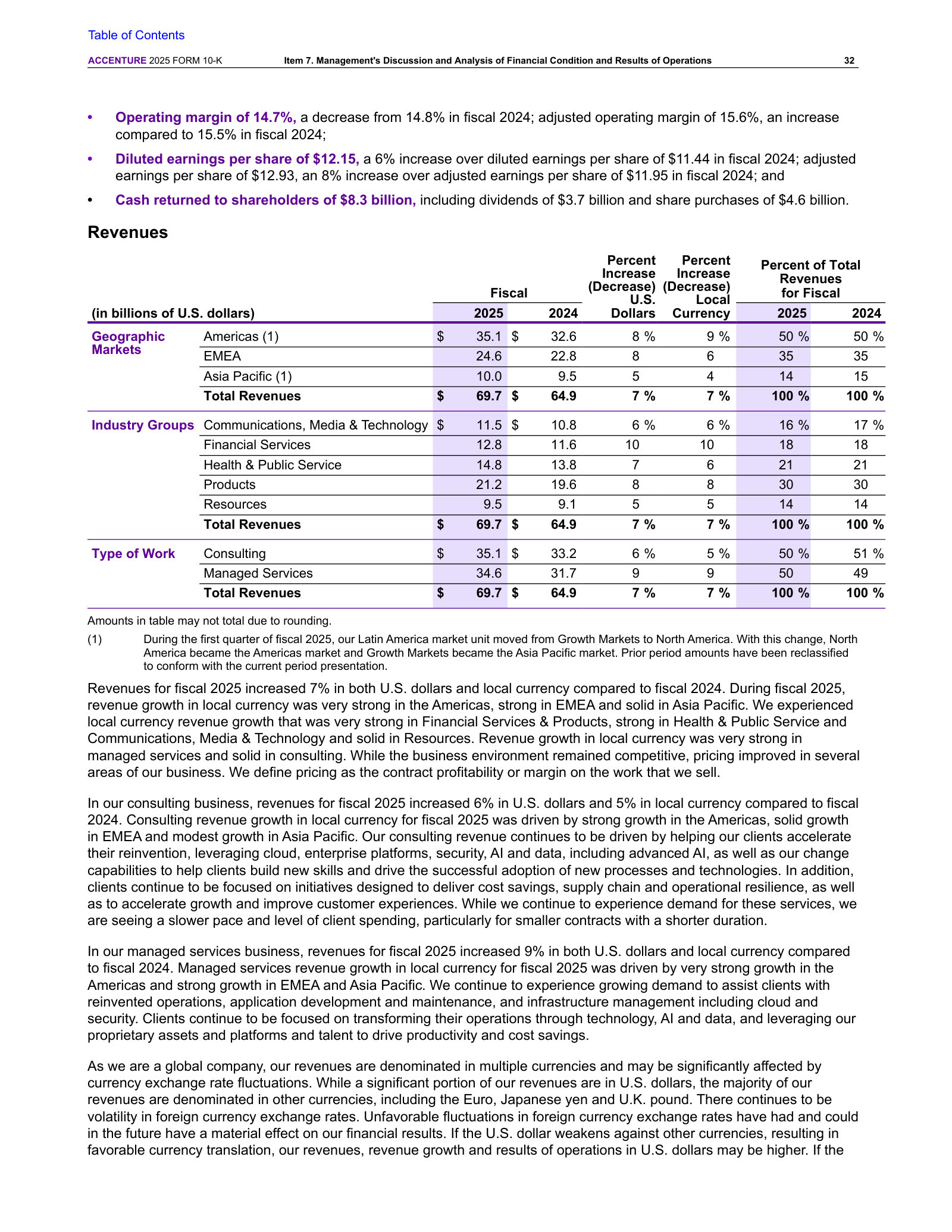
Accenture is a leading solutions and global professional services company that helps the world’s leading enterprises reinvent by building their digital core and unleashing the power of AI to create value at speed across the enterprise, bringing together the talent of our approximately 779,000 people, our proprietary assets and platforms, and deep ecosystem relationships. Our strategy is to be the reinvention partner of choice for our clients and to be the most AI-enabled, client-focused, great place to work in the world. […] We serve clients and manage our business through three geographic markets: Americas, EMEA (Europe, Middle East and Africa) and Asia Pacific. These markets bring together all of our Reinvention Services with both local and global talent and solutions.
We go to market by industry, leveraging our deep expertise across our five industry groups— Communications, Media & Technology, Financial Services, Health & Public Service, Products and Resources. We deliver two types of work: Consulting and Managed Services.
p. 22 · Read in context →
The FY2025 evolution: all services folded into one 'Reinvention Services' unit effective Sept 1, 2025.
Effective September 1, 2025, we brought all of our services, which are described below, together into a single, integrated business unit called Reinvention Services. […] With the majority of our large deals today already involving capabilities across multiple areas, the full rollout of our model is designed to make it faster and simpler to sell and deliver everything Accenture offers across our client base, while embedding more AI and data and equipping our people.
p. 23 · Read in context →
Item 1A. Risk Factors — p. 31 · Read the full section →
The two risks most specific to a labor-arbitrage firm: AI cannibalizing its own billable work, and matching skills to shifting demand.
Item 7. Management's Discussion and Analysis — p. 51 · Read the full section →
Management on what drove results: 7% growth split evenly Consulting/Managed Services, and a real federal (AFS) headwind.
Named headwind: DOGE-driven federal cuts hitting Accenture Federal Services via delayed procurements, price/scope cuts and terminations.
In addition, the U.S. administration is reducing federal spending and the size of the federal workforce under the guidance of the Department of Government Efficiency. We are seeing impacts from these efforts in our federal government business (“Accenture Federal Services, or AFS”), including delays in new procurements, reductions in price and contract scope, and contract terminations. These changes have had an adverse effect on AFS’s results and could in the future have a material impact on our results of operations or financial condition.
p. 51 · Read in context →
Note 1. Summary of Significant Accounting Policies — Revenue Recognition — p. 85 · Read the full section →
The accounting that defines the model: how ~50/50 multi-year Managed Services vs. cost-to-complete Technology Integration revenue is booked.
Two revenue engines: managed services recognized over multi-year terms; technology integration on costs-incurred-to-total-cost progress.
Our managed services contracts typically span several years. Revenues are generally recognized on managed services contracts over time because our clients benefit from the services as they are performed. […] Revenues from contracts for technology integration consulting services where we design/redesign, build and implement new or enhanced systems and related processes for our clients are recognized over time as control of the system is transferred continuously to the client. Contracts for technology integration consulting services generally span six months to two years. Revenue, including estimated fees, is recognized using costs incurred to date relative to total estimated costs at completion to measure progress toward satisfying our performance obligations.
p. 86 · Read in context →
Note 16. Segment Reporting — p. 117 · Read the full section →
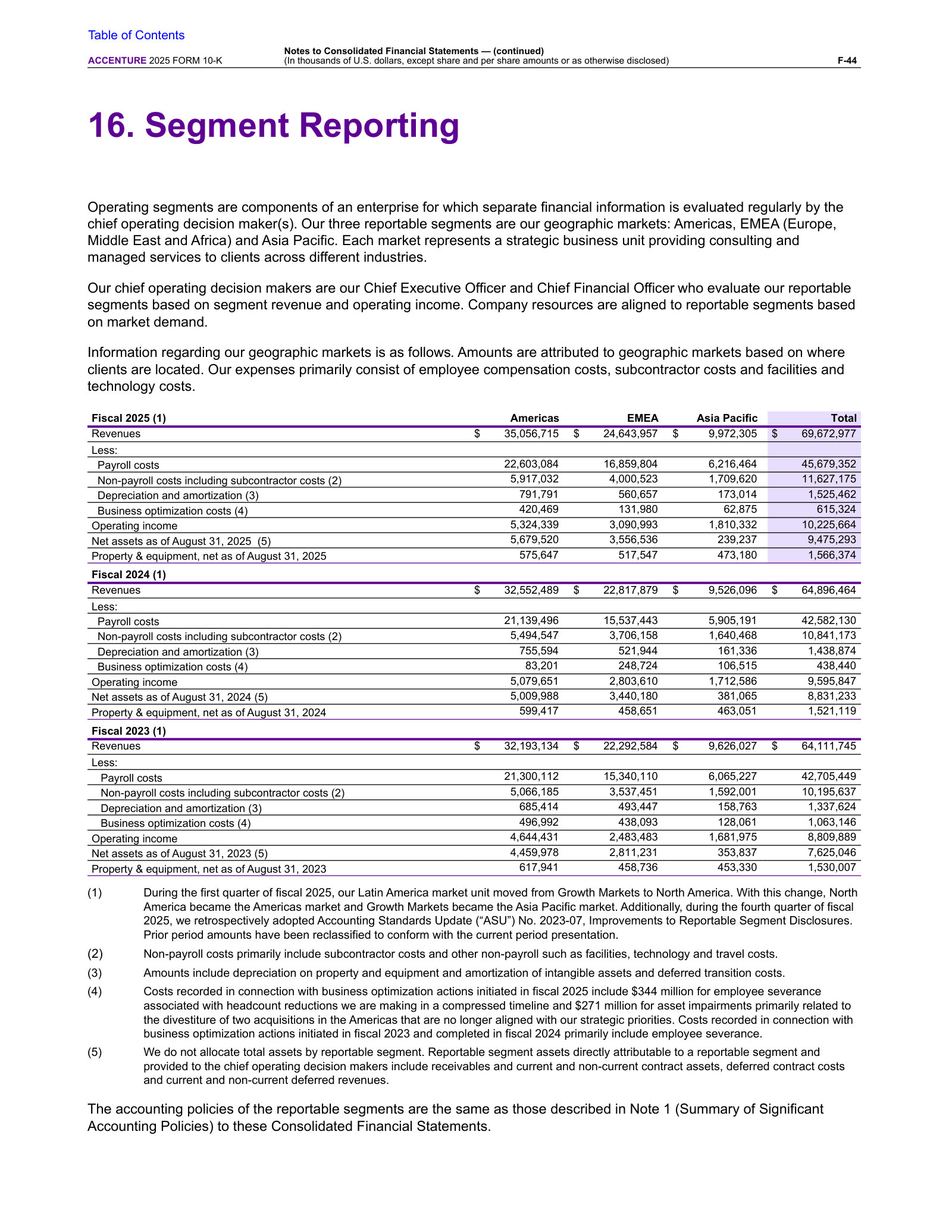
The only audited segment view: Americas/EMEA/Asia Pacific revenue and operating income, with payroll the dominant cost line.
More annual reports
Accenture plc — FY2024 Annual Report (Form 10-K) — FY2024 (year ended Aug 31, 2024) · 123 pages · Prior year: the pre-'Reinvention Services' structure with services still described separately and the earlier geographic-market taxonomy. · Open →
Accenture plc — FY2023 Annual Report (Form 10-K) — FY2023 (year ended Aug 31, 2023) · 119 pages · The year Accenture announced its $3B multi-year generative-AI investment and a large business-optimization/severance program. · Open →
Accenture plc — FY2022 Annual Report (Form 10-K) — FY2022 (year ended Aug 31, 2022) · 99 pages · Peak post-pandemic growth year — useful baseline before the 2023 demand normalization and AI pivot. · Open →
Accenture plc — FY2021 Annual Report (Form 10-K) — FY2021 (year ended Aug 31, 2021) · 102 pages · Earliest edition on the shelf; shows the services taxonomy and disclosures four years before the FY2025 reorganization. · Open →
Accenture plc — FY2025 360° Value Report — FY2025 · 69 pages · Companion ESG/value report expanding the 10-K's '360° value' framing — people, client, and sustainability metrics. · Open →